Showing posts with label journalism. Show all posts

Monday, December 3, 2007

South African Journalist Fired for Blogging

South African journalist Llewellyn Kriel was fired from the newspaper Sowetan last Thursday after blogging about the company's mismanagement on Thought Leader. The official reasoning was that Kriel disclosed confidential information about Sowetan, which the company sent out in an email to employees. Others, Kriel included, viewed the decision as an infringement on freedom of expression. Journalist Arthur Goldstuck quotes Kriel:

“Here is an organisation whose entire existence is premised on freedom of expression. It’s an organisation that continually calls on private and public institutions to account for their behaviour. Yet, they don’t want to be measured by that yardstick.

“If a company is putting out a moratorium on new appointments, surely this is something you can argue is in the public interest to be known? Nothing in the email, and nothing in the way it was distributed, gave any indication of sensitivity or confidentiality at all.”

Sowetan published an article just a week earlier on employees' constitutional right to criticize their employer's management practices.

Andrew Trench ponders what the case may signal for the future of intellectual property rights:

WiIl we see employment contracts in media restricting staff from blogging without the permission of their employer, much like freelance writing clauses which are pretty standard in contracts these days?

What if a staff writer developed a popular blog independently within their own time and was able to sell advertising to generate income from it? How would this be dealt with?

Tuesday, November 13, 2007

Blogging Under Martial Law

BusinessWeek reported yesterday on the Internet's role in informing the public of the state of Pakistan after General Musharraf enforced Martial Law on November 5th and in mobilizing citizens in opposition:
A complete blackout of cable television—the most pervasive medium in Pakistan—radio, and the Urdu press had blocked images from public view, but word spread. The students decided to participate in the protests.

That's when the blogging began. On Nov. 5, the Emergency Times (and an attendant wiki, http://pakistan.wikia.com/wiki/Emergency_2007) appeared. It declared itself "an independent Pakistani student initiative against injustice and oppression," which gave readers a regular update and comments on the emergency, and student activities against it across Pakistan. It announced that there would be a protest by LUMS students on Nov. 7 at 2 p.m., as also at FAST-NU, a technical university in Lahore.

Other protests were organized using Facebook, not just in Pakistan but around the globe, which you can track on Teeth Maestro, a blog that shifted to “crisis mode” after Martial Law was instated. The website also publishes updates on in-country demonstrations and tips for protesters, submitted by readers via Blackberry and email.

With thousands of lawyers and human rights activists in jail and media outlets being pressured to abide by a new "code of ethics," the current situation is a perfect example of how the lines between citizen and professional journalism are becoming blurred. The New York Times recently appealed to Pakistani citizens to submit eyewitness accounts of blocked protests via text, video, or photographs.

Last week Dr. Awab Alvi, who formerly ran Teeth Maestro, warned fellow bloggers of the dangers they may face in light of this power:

I THINK ITS TIME THAT ALL PAKISTAN BASED BLOGGERS SHOULD STOP BLOGGING AND BE CAREFUL SINCE ITS BEING CONFIRMED THAT MARITAL LAW IS IN EFFECT WE ALL HAVE TO PLAY IT SAFE - HAND OVER REIGNS TO INTERNATIONAL REPORTERS AND BLOGGERS TO HELP REPORT - WE CANNOT RISK IT HERE

Other bloggers have decided to remain anonymous, fearing their opposition movement may be hampered by leakages of information in the press.

With any media coverage of conflict or civil unrest come ethical questions: Should reporters risk their lives to get accurate information to the public? Under what circumstances can unnamed sources be used and trusted?

The situation in Pakistan suggests that bloggers too now have to ask these same questions of themselves.

Monday, November 12, 2007

I Built My Blog of Glass

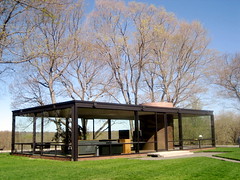
Philip Johnson's Glass House, Photo by Mel KThe article about how the New York Times is striving to maintain an editorial policy of "civil discourse" in the comments on its blogs raises some interesting issues (Matthew Hennessey touched on a few here). It led me to think that in some ways blogs blur the lines between public and private space. For example, if you have an open house party and a guest leaves footprints on your walls you're well within your rights to give him the boot. But discouraging similar unruliness by deleting or editing comments on a blog can quickly lead to accusations of censorship.

This issue is compounded by the fact that blogs are hosted and owned in a number of different ways, from free public services like Blogger to proprietary and commercial institutions of journalism like the NYT. That's why bloggers and hosts develop content policies and terms of service to set the rules of use, indemnify themselves, reserve rights, etc. Otherwise all the huffing and puffing might blow their blog down.

It seems natural then, given the public/private nature of blogs, that many would adopt a "house rules" approach to filtering content, and transparency comes from making that policy explicit. Do the blogs of journalists, press, and media carry unique or additional responsibilities for disclosure or tolerance? Many letters to the editor never see the light of day, but there's no public outcry over that.

Photo of Philip Johnson's Glass House by Mel K (CC).